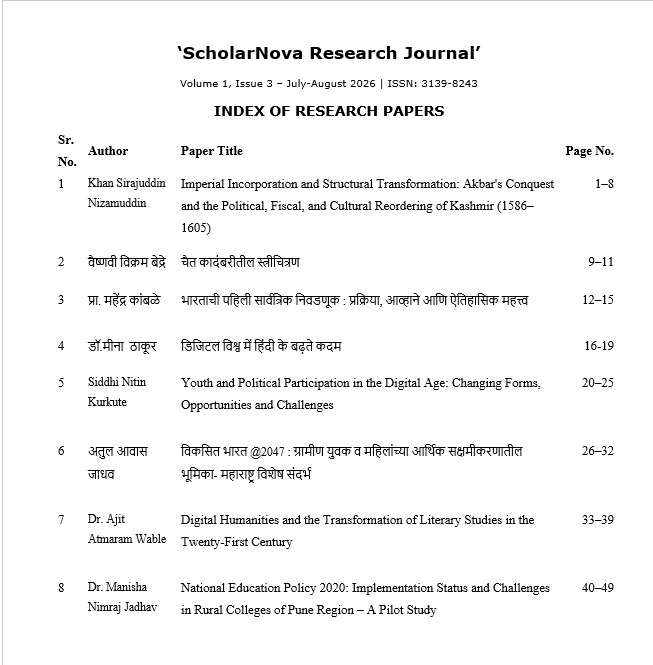
National Education Policy 2020: Implementation Status and Challenges in Rural Colleges of Pune Region – A Pilot Study
Keywords:
multidisciplinary education, credit system, curriculum reform, higher education, NEP implementation, : National Education Policy 2020Abstract
The National Education Policy (NEP) 2020 represents a significant shift in the structure and philosophy of Indian education. It seeks to create an education system that is multidisciplinary, flexible, inclusive, skill-oriented and responsive to the changing requirements of learners and society. The policy gives considerable attention to equitable access, quality enhancement, technology-enabled education, vocational learning, research and the holistic development of students. However, translating these provisions into practice can be particularly challenging for rural higher education institutions because of differences in infrastructure, digital facilities, faculty preparedness, institutional resources and socio-economic conditions. Rural colleges in Pune District provide higher education opportunities to a substantial section of students who may otherwise have limited access to higher education. The implementation of NEP 2020 in these institutions therefore requires careful examination at the institutional level. The present pilot study attempts to assess the implementation status of selected NEP-related administrative and academic reforms in 59 rural colleges. Particular attention is given to institutional governance, programme structure, credit implementation, semester-wise credit patterns, credit categories and subject-choice baskets. The findings indicate that important administrative mechanisms have been established in most of the selected institutions. However, significant gaps remain in the implementation of four-year undergraduate programmes, honours with research, multidisciplinary subject choice, internship, research components and other provisions associated with the complete NEP framework. The study also identifies operational difficulties relating to curriculum restructuring, major-minor combinations, multiple entry and exit, Academic Bank of Credits and skill development. The findings suggest that institutional preparedness, faculty capacity building, technological support, academic planning and stronger collaboration with external stakeholders are essential for effective implementation of NEP 2020 in rural colleges.