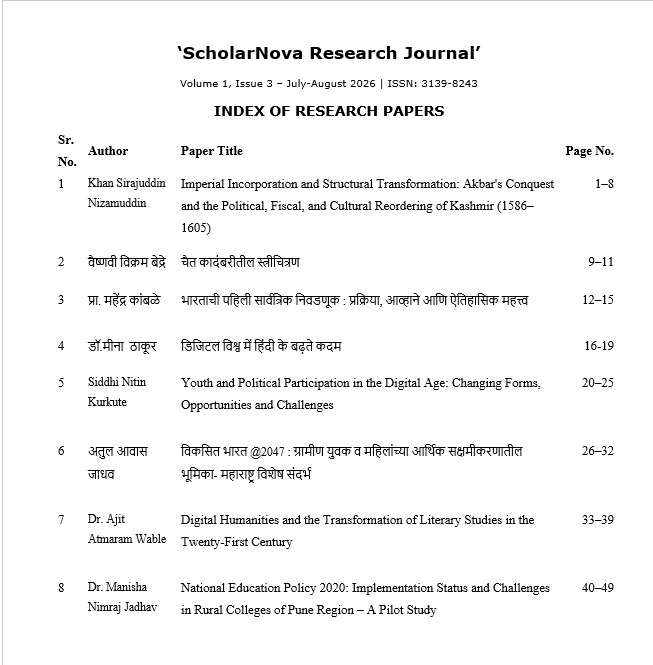
Digital Humanities and the Transformation of Literary Studies in the Twenty-First Century
Keywords:
Computational Literary Studies,, Close & distant Reading, digital Literary StudiesAbstract
The emergence of Digital Humanities has significantly transformed the methods, practices, and possibilities of literary studies in the twenty-first century. Traditionally, literary scholarship has been associated with close reading, textual interpretation, historical contextualization, theoretical analysis and critical engagement with individual literary works. The development of digital technologies has expanded these practices by introducing computational text analysis, digital archives, data visualization, corpus linguistics, stylometry, network analysis, geographical mapping, text mining and distant reading. Digital Humanities creates new possibilities for examining literature at different scales. This research paper examines the transformation of literary studies through Digital Humanities. It discusses the historical development of Digital Humanities from humanities computing to contemporary computational literary studies and examines important concepts such as close reading, distant reading, macro analysis, algorithmic criticism, digital archives and visualization. The paper also considers the contribution of scholars. Particular attention is given to the ways in which digital methods enable scholars to study large collections of texts, identify patterns, compare literary works, examine authorship and style and visualize relationships among characters, places, themes, and historical periods. At the same time, the paper argues that Digital Humanities presents important challenges, include questions of interpretation, algorithmic bias, digitization, accessibility, copyright, technological inequality and the danger of reducing literature to quantitative data. Therefore, the future of literary studies lies not in choosing between traditional and digital methods but in developing a productive dialogue between close reading and computational approaches.