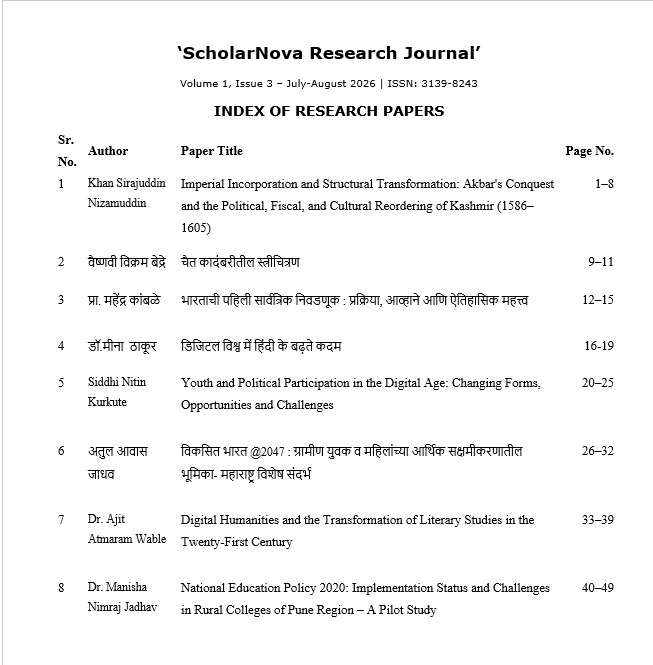
Imperial Incorporation and Structural Transformation: Akbar's Conquest and the Political, Fiscal, and Cultural Reordering of Kashmir (1586–1605)
Keywords:
Agrarian Policy, Akbar, Mughal Empire, Kashmir SubahAbstract
This paper reads Akbars 1586 annexation of Kashmir not as a single military occurance but as the opening move in a two-decade process of imperial incorporation that ran until emperors’ death in 1605. Drawing together the Mughal court records- mainly Abul Fazls Akbar Nama and Ain I Akbari with kashmirs local authored texts such as Baristan I shahi and Haider Malik chandras Tarikh I Kashmir situating both against secondary scholarship of N. K Zutshi,Irfan habib, abd Richards and hasan the study traces three changes: Administrative restructuring for which chak rulers gave away to Sarkar and fajudars Arrangement; fiscal reassessment, for which Akbars standard zabt-dahsala cash system was withheld in favour of crop sharing suited to kashmirs terrain; and socio-cultural reordering which was driven by persian literary patronage including shawl kharkhana economy. Using a qualitative, documentary-historical method, the paper finds that incorporation proceeded unevenly, through negotiation and periodic crisis rather than uniform imposition, and argues that Kashmir's experience offers a useful corrective to readings of Mughal expansion as a single administrative template applied without variation across the empire.